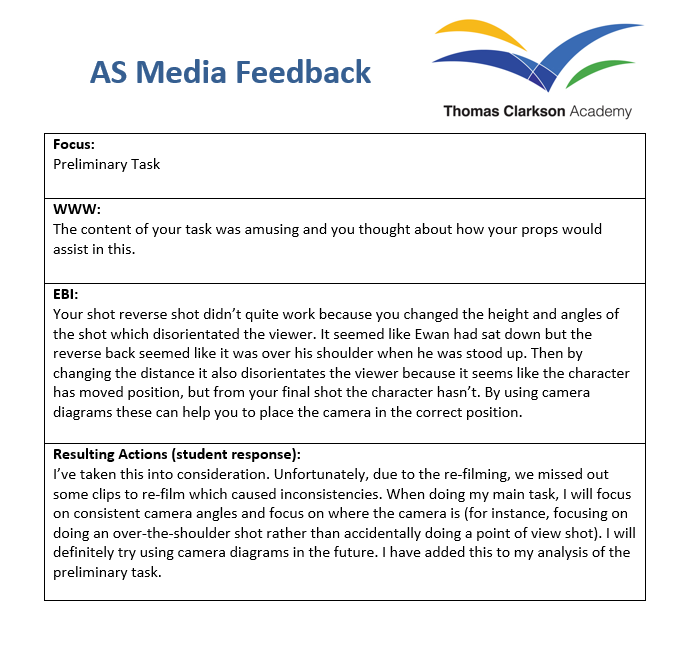
Doing the preliminary task, I've learned a lot about the process of filming, the kind of shots we needed to use and positioning the camera. As this was the first time I'd filmed anything like this, I've definitely furthered my skills in camera work and editing, knowing what shots should go where and what kind of shots to use for certain situations, for example, shot reverse shot for conversation, and match on action for a character entering a room. Editing was a fairly easy process as I'd edited before, but I certainly got more familiar with the process. The only reason it was difficult was because of the program that I used, which crashed consistently and was very slow (due to the low spec computers). It was quite difficult to get the shots to be consistent, for instance, with the positioning of the camera, as well as figuring out continuity editing from a technical view (especially match on action and making the movement from outside of the room to the inside look feasible). For feedback, we watched the video in class where it was looked at critically for its technical merit. What was pointed out is the fact that we used more POV shots than over-the-shoulder shots that we were meant to use for shot reverse shot. So, less like this...
...And more like this.
I think the preliminary task could be improved greatly. As our original filming did not meet the criteria, we had to re-shoot certain scenes. However, we used a different camera, and the difference in equipment shows in the final product, as the quality of the audio and video changes significantly between certain shots. For future reference, we will stick to using the same equipment to avoid these inconsistencies. We will also focus on getting the shots correct, for instance, using over-the-shoulder shots rather than POV shots, and making sure the perspective is correct.
There was also quite a bit of deviation from the storyboard, so I'd have to make sure that's all correctly carried out and that what we would be attempting is do-able.
If we were to do the task again, I would make sure we were prepared and had planned everything out. For example, I would shoot everything from one location first then move on to the next. I would also focus on making sure I met all of the criteria as much as possible. The reason being so I could get the maximum number of marks, whilst making it as easy and seamless as I could.
Person A walks down the corridor towards the meeting room. They go in for the handle (close-up shot of their hand) and walk in, the next shot being shown facing the door from inside the room. They close the door whilst facing it and turn the light on. They turn around and have a moment of realisation and look shocked.
The camera then cuts to a scene of Person B and C, in balaclavas, holding Person D hostage and threatening them with vegetables.
Silence is shared between them whilst various shots are shown.
There is then a close-up of Person A's face.
Person A: "I think I'm in the wrong room..."
Person B: "No worries, it's happened before."
Silence is shared once again, before Person A reaches out for the door handle, struggling to take their eyes off of the scene. They then leave, and exit through the door, walking along the corridor looking utterly confused.
We decided that the location should be a small room for idea 1 to take place, as they would be a good setting for a hostage situation. We looked at a couple of meeting rooms as they are often unused and quiet. The location we decided on is a meeting room without windows, so we could use the darkness to our advantage by shedding light on the situation (literally).
With our location we are trying to imitate a location where a hostage situation or interrogation to take place - small, and (preferably) dimly lit.
The preliminary task is a filming activity where we explore camera shots and angles, lighting and continuity editing.
Continuity editing is used to make shots flow and look consistent. Examples of continuity editing include match on action, shot reverse shot and the 180 degree rule.
Match on action refers to when an editor cuts from one shot to another whilst continuing the action through the shots. For example, a person may be shown opening a door from over their shoulder, then in the next shot they're filmed opening the door from the other side. This particular example is something we'll be using in the preliminary task.
Shot reverse shot is typically used in conversations between two characters. The first shot shows the face of the first character over the shoulder of the second character, then switches to the face of the second character over the shoulder of the first character, and so on. It's used to make the transitions between shots look smoother, as the viewer perceives the action as being continuous. We'll be using this kind of shot whenever two or more characters interact.
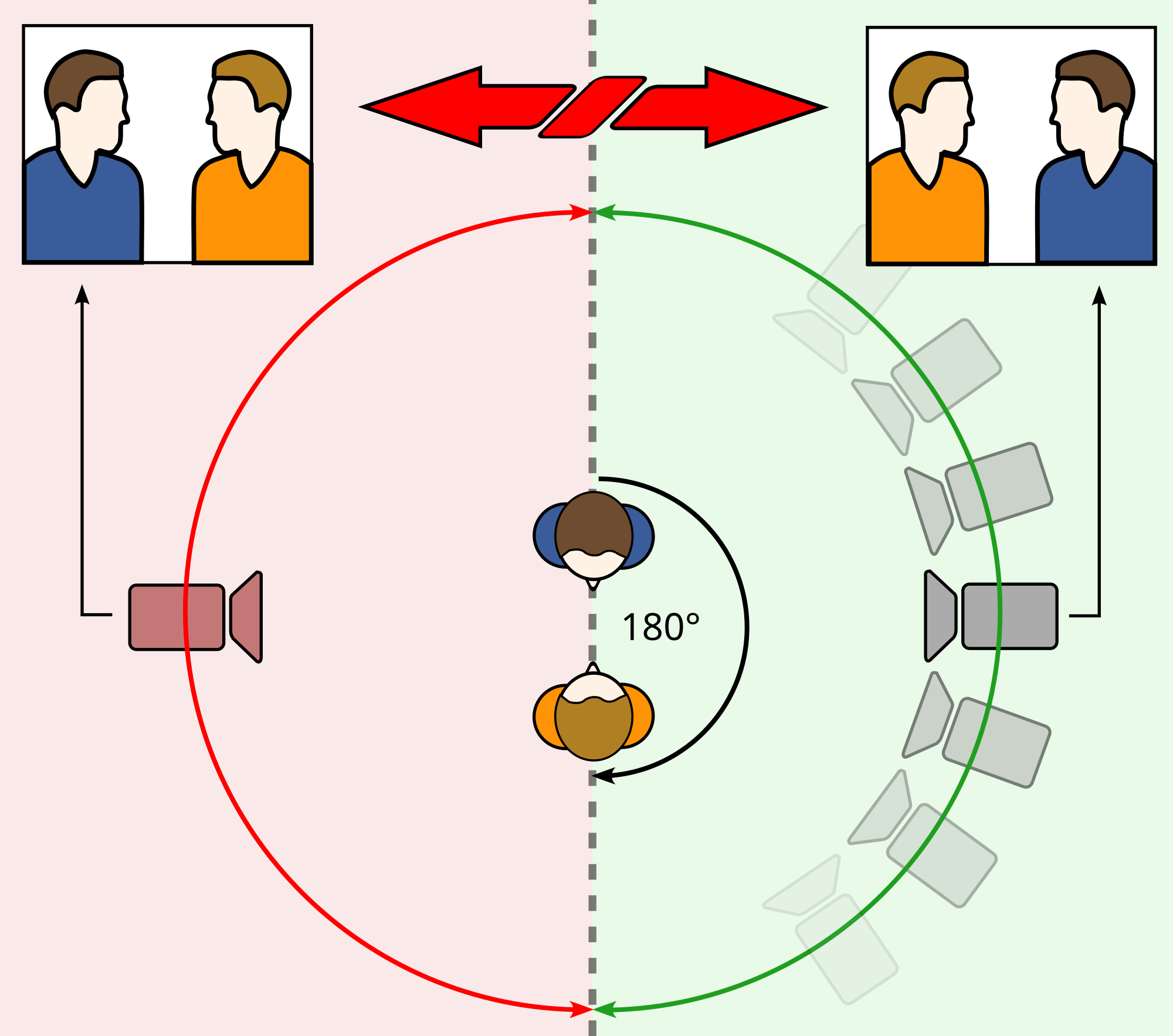
The 180 degree rule refers to the position of the camera according to the line of action (the line of action being, for example, a conversation between two characters).
The camera can move anywhere in this 180 degree semicircle but must remain behind the line of action. This is so the characters shown are always in a certain place on-screen, for example, the first character will always be on the right and the second character will always be on the left. This way the viewer understands what's going on and doesn't get confused. If the person filming/editing wants to 'cross the line' onto the other side, they must have a shot showing the change from one side of the line of action to the other. The camera then must remain in that 180 degree semicircle, unless the transition over the line of action is shown again.
The aim of the preliminary task is to use all of these examples of continuity editing in a short scene as a way of understanding how to film and edit as well as experiment with different ways of filming before going into the main task. In order to explore the technical side of media, we have to come up for a story and script for the scene beforehand.